Micro-Frontends and Design System Drift: Keeping UI Consistent Across Teams
How teams using micro-frontends keep one consistent UI: shared tokens and components as versioned packages, CSS isolation, upgrade policies and visual regression checks.
Core Takeaway
Micro-frontends let teams deploy parts of a product independently, which makes UI drift likely: different versions of components, conflicting CSS and duplicated styles. Keep consistency by sharing design tokens and components as versioned packages, isolating each team's CSS, agreeing an upgrade policy, and catching differences with visual regression tests.
Why drift happens
Martin Fowler's site describes micro-frontends as independently deliverable frontend applications composed into a greater whole, with independent deployment as a key benefit. The same independence causes drift: teams upgrade the design system at different times, copy components to move faster, and write CSS that leaks into other parts of the page. The article also warns that some implementations duplicate dependencies and that CSS, being global and cascading, needs deliberate isolation.
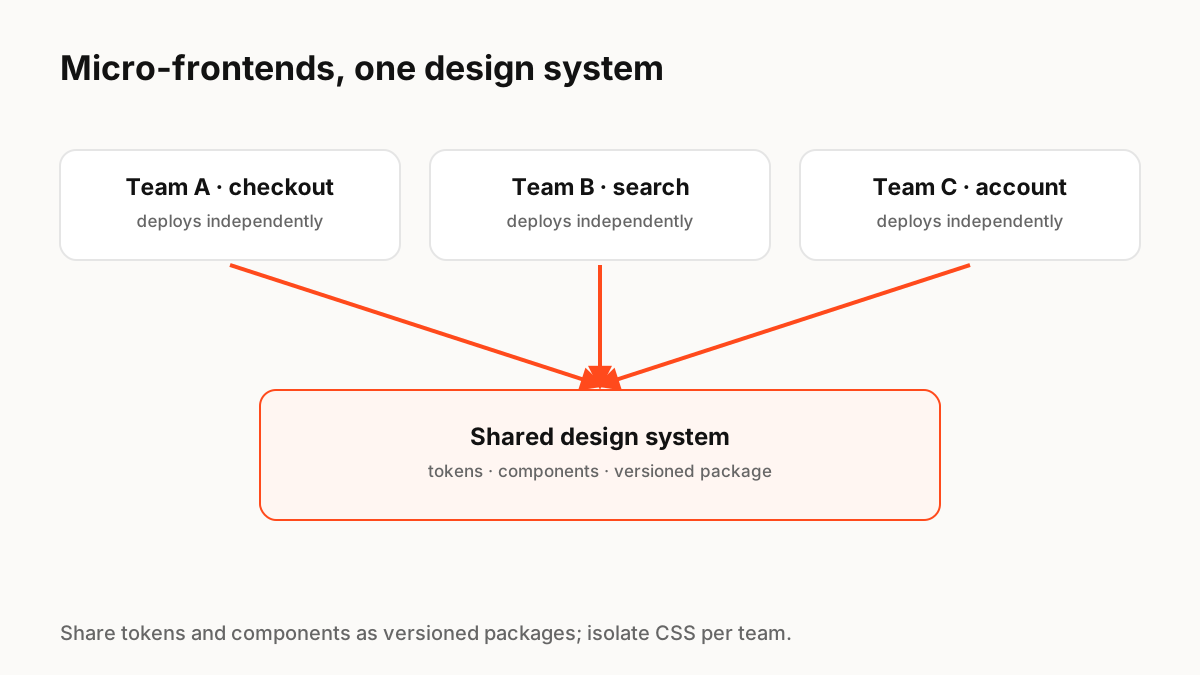
Share the system as packages
Publish tokens and components as versioned packages, not copy-pasted code. Tokens in a standard format, such as the W3C DTCG format, can be built for every framework a team uses, so a React team and a Vue team still share the same colours, spacing and motion.
Isolate CSS
Prevent styles from leaking between teams with a consistent approach: naming conventions such as BEM, CSS Modules, CSS-in-JS, or Shadow DOM for web components. Pick one convention for the whole product and lint for it.
An upgrade policy
Agree how far behind a team may fall, for example no more than one major version, and use semantic versioning so teams know when changes are breaking. Track which version each micro-frontend uses in a shared dashboard.
Catch drift automatically
Visual regression tests on key screens, lint rules that forbid raw colour and spacing values, and design reviews on shared surfaces (headers, navigation, checkout) catch inconsistencies before users see them.
Key Principles to Remember
- Independent deployment makes UI drift likely
- Share tokens and components as versioned packages
- Isolate CSS with one consistent approach
- Agree an upgrade policy and track versions
- Use visual regression tests and lint rules
Frequently Asked Questions
Sources
- Micro Frontends — martinfowler.com
- Design Tokens Community Group — designtokens.org
- Semantic Versioning 2.0.0 — semver.org