Use case · Design systems
Design system motion from one source.
Updated November 2026
ExodeUI helps teams keep design system motion consistent from one source, so the product feels like one product on every platform. Components read shared motion tokens, such as one spring, one accent and one corner radius, so a single change updates every component. The files run on web, iOS and Android, and the CLI can lint tokens and flag breaking changes before a release.
- One change, every componentEdit the house spring once and every component follows.
- Same feel on every platformThe same files run on web, iOS and Android.
- Changes you can reviewLint tokens and flag breaking changes before a release.
Free Community plan · Browser, macOS and Windows
 Open in ExodeUIFree
Motion guidelines nobody can enforce
The usual way
- Each platform team picks its own durations and easing, and the products drift apart.
- Motion guidelines live in a document that code does not read.
- Changing the house spring means editing dozens of components by hand.
With ExodeUI
- Components read named tokens instead of raw numbers.
- One file per component runs on web, iOS and Android.
- The CLI lints files against the tokens and diffs versions in CI.
What happens in the demo
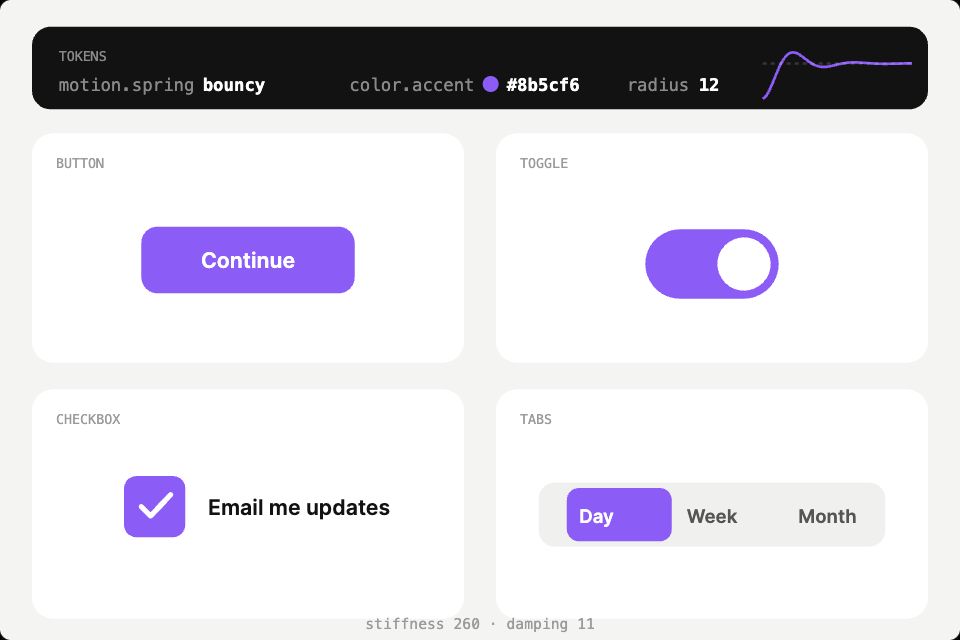
Each component in the demo reads the same three tokens. That is the whole idea of motion tokens: decide the feel once and every component inherits it.
- The brand wants a calmer feel
spring: "smooth"Every press, slide and tick settles without overshoot. The curve in the token bar flattens - A product needs playful motion
spring: "bouncy"The knob, the tab pill and the check all overshoot and wobble back - A white-label client has another colour
accent: "#3b6bff"All four components retint at once - The system moves to sharper corners
radius: 2Buttons, tabs, knobs and checkboxes all square off together - A user clicks a component
press · toggle · check · tabIt moves with the shared spring and tells your code
Put one component on shared tokens
Start with the primary button. Give it the house spring and accent as tokens, then change the spring and watch it update everywhere it is used.
Free Community plan to start. Professional is $5 a month, billed yearly.
What you can build for design system motion
Animated core components
Buttons, toggles, tabs and inputs with every state built in.
Motion tokens
Named springs, durations and easings that every file reads.
Feedback patterns
Success, error and loading states that look the same in every product.
Themes and white-label
One set of components, retinted and reshaped by tokens per brand.
Documentation pages
Live, clickable examples instead of GIFs in your docs.
Platform parity
The same component on React, Flutter, SwiftUI and React Native.
Drive it from your code
These are the real inputs and events of the demo above. Your app sets the inputs; the file decides how each change looks.
| Name | Type | What it does |
|---|---|---|
spring | Text | The motion token: snappy, bouncy or smooth. |
accent | Text | The colour token, as a hex value. |
radius | Number | The corner radius token, 0 to 24. |
press, toggle, check, tab | Event | Fire when someone uses a component. |
import { ExodeUICanvas } from 'exodeui';
import { tokens } from '@acme/design-tokens';

// Every animated component reads the same tokens.
export function DSComponent({ src, onEvent }) {
  return (
    <ExodeUICanvas
      src={src}
      autoPlay
      fit="Layout"
      inputs={{
        spring: tokens.motion.spring,
        accent: tokens.color.accent,
        radius: tokens.radius.md
      }}
      onTrigger={onEvent}
    />
  );
}
How you build it
- 1Define the tokens
Set the springs, durations and curves your system allows.
- 2Build the components
Make each component once, with the states and inputs your engineers expect.
- 3Check every change
Run lint, verify and diff in CI to catch breaking changes.
Features for motion tokens and component libraries
The CLI checks files against your tokens.
See what changed between versions and whether it breaks consumers.
Generate TypeScript types and Zod schemas for each file's inputs.
Audit files against WCAG and export the report.
More live examples
When another tool is the better fit
If your system only needs a short list of durations and easings, CSS custom properties or a tokens package may be enough. ExodeUI helps most when components carry illustration, physics or many states that are hard to keep in sync by hand.
Questions
What is design system motion?
It is the shared set of rules, tokens and components that make animation consistent across a product: durations, easings, springs and how each component moves between states.
What are motion tokens?
Named values for timing and easing, such as spring-bouncy or duration-fast, that components use instead of raw numbers. Change the token and every component that uses it changes.
How do you keep motion the same on iOS, Android and web?
Build the motion once in a format that runs on every platform. ExodeUI files run with runtimes for web frameworks, Flutter, SwiftUI and React Native.
Can we review motion changes in pull requests?
Yes. Files are JSON, and the CLI can diff two versions and flag breaking changes.
Does it work with our existing components?
Yes. Use ExodeUI for the animated parts and keep the rest of your component code as it is.
How do we get the team to adopt it?
Start small. Move one component onto shared tokens and show the diff when the spring changes. One visible change is easier to agree on than a guideline document.
Who owns the motion tokens?
Usually the design system team, the same people who own colour and type tokens. Product teams use the tokens and do not set their own durations.
Related reading
Decide the feel once. Ship it everywhere.
Free to start. Your .exode files are open JSON that you own.
Other use cases: mobile apps, websites, product design, ai coding agents, games, game ui, character animation, automotive, broadcast & streaming, film & tv, education & science.