How to Pitch UX and Design Debt Cleanup to Engineering and Product Leaders
What UX debt is, how to inventory and prioritise it, and how to pitch cleanup and design system refactors in terms leaders fund: risk, cost and revenue.
Core Takeaway
UX debt is the build-up of experience problems from shortcuts, like technical debt for design. To get cleanup funded, make it visible with an evidence-backed inventory, prioritise by user impact, frequency and effort, ask for a steady budget (a share of each sprint) rather than a big rewrite, and report progress in the measures leaders already track.
What UX debt is
Nielsen Norman Group describes UX debt as experience problems that pile up when teams repeatedly choose fast, easy solutions, similar to technical debt, a term Ward Cunningham coined in 1992. Left unaddressed, it leads to compounding user problems and costly cleanup. Examples include inconsistent components, confusing flows that were "temporary", and outdated patterns kept for convenience.
A four-step pitch
Leaders fund what they can see and measure:
- Inventory: list issues with evidence such as research clips, support tickets, analytics and bug reports.
- Prioritise: rank by user impact, how often it occurs and effort to fix.
- Budget: ask for a fixed share of each sprint instead of a big-bang redesign.
- Show progress: before-and-after metrics for each fixed item.
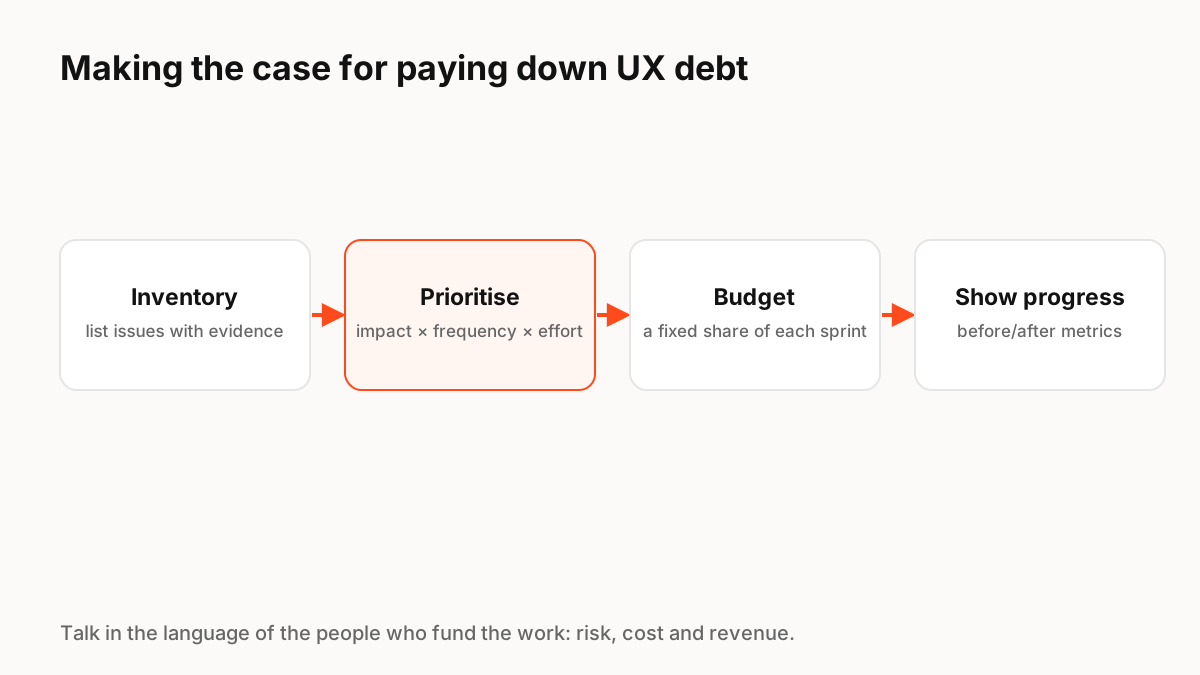
Speak the language of the people who fund it
Translate each item into risk, cost or revenue: "this checkout inconsistency generates N support tickets a month", "duplicate button components add a day to every feature", "this flow fails accessibility rules we must meet". Pair each with an estimate, using the same approach as UX ROI calculations.
Find it early
NN/g recommends getting real user feedback often and in a variety of ways, with testing before sprint releases and ongoing testing at least monthly. Add UX debt items to the same backlog as technical debt so they are visible in planning, not in a separate design document nobody reads.
Design system refactors
For system-level cleanup, show the cost of not doing it: how many variants of the same component exist, how long new features take, and how many UI bugs trace back to inconsistency. A small pilot, refactoring one high-traffic area first, makes the case better than a slide.
Key Principles to Remember
- UX debt is accumulated experience problems from shortcuts
- Inventory with evidence, then prioritise by impact, frequency and effort
- Ask for a steady budget, not a big rewrite
- Translate items into risk, cost and revenue
- Track UX debt in the same backlog as technical debt
Frequently Asked Questions
Sources
- UX Debt: How to Identify, Prioritize, and Resolve — Nielsen Norman Group
- Calculating ROI for Design Projects in 4 Steps — Nielsen Norman Group